Extreme FlexibilityOver 300% elongation across temperature swings
Time-Tested Synthetic Rubber Systems · Silver Spring, MD
EPDM roofing is a trusted standard across Silver Spring commercial flat and low-slope facilities—including office parks, multifamily apartment buildings, and industrial warehouses. Its flexible vulcanized rubber membrane delivers exceptional elongation across extreme seasonal temperature swings, long-term UV resistance, and durable waterproofing protection.
Proven Rubber Engineering
EPDM (Ethylene Propylene Diene Monomer) has protected commercial buildings for over half a century. Its physical material characteristics make it particularly suited for the Mid-Atlantic climate:
Unlike thermoplastic sheets that can become brittle in freezing winter temperatures, EPDM remains pliable and flexible well below zero degrees. It expands and contracts naturally with building thermal movement without cracking, splitting, or pulling away from perimeter anchors.
Because carbon black is an intrinsic component of the vulcanized rubber polymer chain, black EPDM naturally blocks ultraviolet degradation without losing elasticity or experiencing surface chalking over decades of sun exposure.
EPDM is manufactured in panels up to 50 feet wide and 100 feet long. On large open commercial rooftops, this dramatically reduces the total number of field seams required compared to narrow roll products, minimizing potential leak entry points.
Whether your commercial facility requires a fully adhered system bonded with contact adhesive, mechanically attached fasteners engineered for high wind zones, or a ballasted river rock system, EPDM adapts to structural requirements.
Punctures or separated laps on older EPDM roofs can be cleanly restored. Using specialized EPDM quickprime primers, uncured moldable flashing tapes, and heavy silicone seam rollers, technicians restore permanent watertight integrity.
EPDM is one of the most environmentally sustainable roofing materials available, featuring low embodied energy during manufacturing, zero toxic runoff, and 100% recyclability into new commercial products at end-of-life.
Full Lifecycle Commercial Service
From new commercial construction to restoring 20-year-old rubber seams, our Silver Spring commercial technicians specialize in the nuances of rubber membrane engineering.
We prepare underlying decking, install rigid polyiso insulation boards, lay high-density cover boards, and adhere or mechanically fasten large seamless EPDM panels. Specialized attention is dedicated to pipe penetrations, HVAC curb corners, and termination bars.
When an aging rubber roof has suffered widespread seam failure, membrane shrinkage pulling away from parapet corners, or saturated underlying insulation, we execute comprehensive replacement projects with zero disruption to daily commercial tenant operations.
Punctures from dropped HVAC tools, separated field laps, and dried-out perimeter sealants can allow water underneath the membrane. We clean the rubber, apply factory primer, install cured or uncured self-adhering EPDM tapes, and seal with continuous lap sealant.
System Selection
Each attachment method offers distinct advantages depending on structural deck capacity, building height, and architectural design:
The rubber membrane is fully cemented directly to compatible insulation cover boards using solvent-based or water-based bonding adhesives. This creates a smooth, flat aesthetic surface with maximum resistance to wind uplift pressures. Highly recommended for buildings with unusual roof geometry or high wind exposure.
Membrane panels are anchored using heavy-duty steel fasteners and seam plates secured directly into the structural deck along sheet lap edges. Seams are then bonded with double-sided seam tape. Fast, economical, and ideal for steel and wood commercial roof decks.
The membrane is loose-laid across insulation without fasteners or glue, and held in place by washed river stone ballast or architectural concrete pavers (typically 10-12 lbs per sq ft). Very economical for heavy concrete structural decks capable of supporting the ballast weight.
Local Silver Spring Track Record
Take a look at recent commercial rubber roof installations and precision seam restorations completed by our crew:
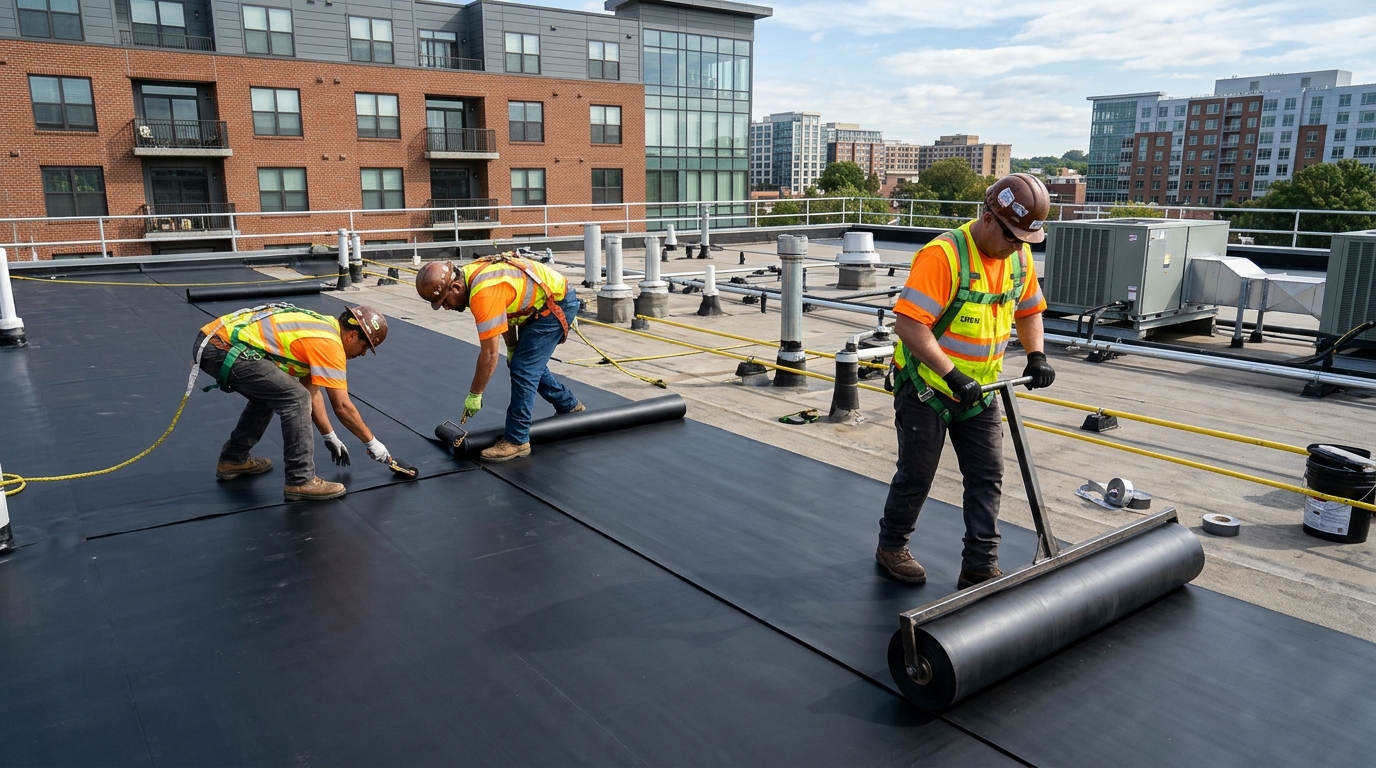
Installed heavy-duty 60-mil black EPDM rubber membrane across multiple connected roof sections of a 4-story multifamily apartment complex. Used 100-pound weighted membrane rollers to achieve 100% adhesive bond, with fully detailed expansion joints.
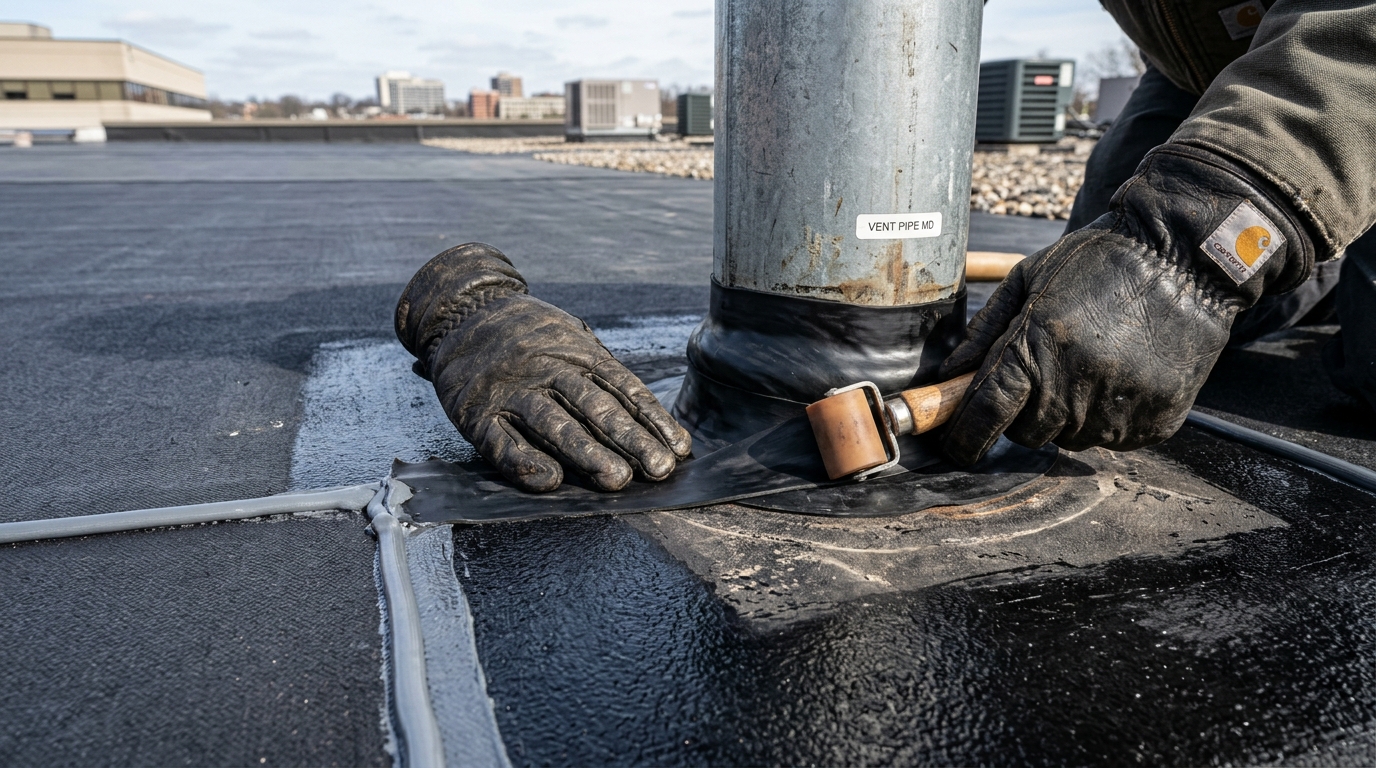
Remediated water infiltration around multiple rooftop mechanical conduit pipes. Stripped back deteriorated caulking, prepared the rubber with weather-guard primer, and hand-rolled uncured moldable EPDM flashing collars with continuous edge lap sealant.
Commercial Client Feedback
“Our apartment building had an older ballasted EPDM roof that was starting to leak around the perimeter gravel stops. Roof Repair Silver Spring vacuumed the stone, inspected every seam, repaired the separated transitions, and secured the edge metal. Honest, transparent, and highly skilled commercial contractors.”
“When HVAC mechanics accidentally sliced our commercial rubber roof during a compressor replacement, water flooded our second-floor office. Roof Repair Silver Spring responded within 90 minutes on a stormy afternoon, made an emergency patch, and returned the next day to permanently weld a new reinforced EPDM collar. Lifesavers!”
“We manage several commercial properties throughout Montgomery County. We always turn to Roof Repair Silver Spring for our EPDM roof replacements and preventative maintenance inspections because they deliver clear photo reports, fair pricing, and flawless workmanship.”
Clear Technical Answers
Everything you need to know regarding rubber membrane lifespan, seam integrity, and repair options:
A well-maintained 60-mil or 90-mil EPDM rubber roof typically lasts between 25 and 30+ years in Maryland. Its carbon-black synthetic polymer chain does not degrade under solar UV exposure, giving it one of the longest field track records in modern commercial roofing.
Yes. EPDM is one of the easiest commercial membranes to repair. The surface is thoroughly cleaned with specialized solvent cleaner, primed with EPDM primer, and covered with self-adhering cured EPDM patch tape hand-rolled with heavy pressure and sealed along the edges.
Common causes of EPDM leaks include aged seam tape separation, failed pitch pockets around rooftop conduits, shrinkage pulling the membrane away from parapet wall corners, and mechanical punctures from rooftop AC servicing.
Neither is automatically better; the choice depends on your building envelope goals. White TPO is a reflective cool roof ideal for cutting summer cooling costs. Black EPDM offers superior thermal elasticity and performs exceptionally well during freezing winter months. Contact our team to compare thermal calculations for your building.
Traditional EPDM is black due to carbon black added during vulcanization, which naturally blocks UV degradation. White EPDM has a titanium dioxide surface formulation designed to reflect solar heat, though it typically carries a slightly higher material cost.
Yes, if the rubber membrane is well-adhered and underlying insulation has not suffered moisture saturation. Elastomeric or 100% silicone roof coatings can be applied over properly primed EPDM to extend service life by 10 to 15 years.
In many commercial applications, an existing single-ply or smooth asphalt roof can be covered with an EPDM recover system if core tests confirm the insulation is dry and local building codes permit a second layer.
Commercial EPDM roofing installation and replacement typically ranges between $5.50 and $10.50 per square foot depending on membrane thickness, insulation R-value, attachment method (adhered vs fastened vs ballasted), and rooftop equipment density. Call (301) 872-7857 for an itemized estimate.
Direct Commercial Consultation
Connect with Roof Repair Silver Spring's commercial team to schedule an on-roof evaluation and receive an itemized, transparent project proposal.